
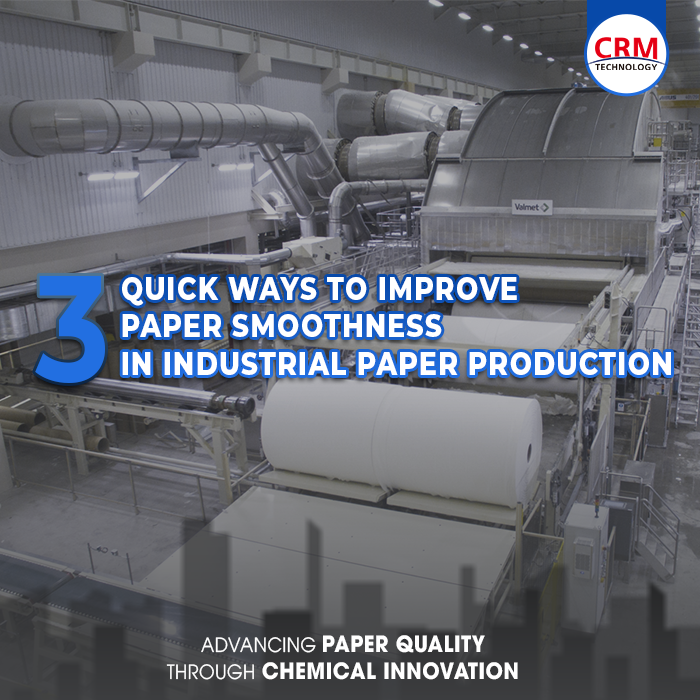
Paper smoothness is one of the most important quality parameters that directly affects printability, surface feel, and the overall commercial value of paper products. In industrial paper production, rough or uneven paper surfaces can lead to printing defects, higher waste rates, and reduced processing efficiency.
This article outlines three quick and practical ways to improve paper smoothness, commonly applied in modern paper mills.
Paper smoothness refers to the flatness and uniformity of the paper surface, typically evaluated through print performance, gloss, and tactile feel.
High paper smoothness helps improve printing quality, reduce ink spreading, minimize wear on printing equipment, and enhance the market competitiveness of paper products. Conversely, rough paper surfaces often cause printing errors, increase reject rates, and lower overall production efficiency.
Pulp refining plays a critical role in determining fiber structure and fiber bonding within the paper sheet.
Insufficient refining results in stiff fibers with poor bonding, leading to a rough paper surface. Excessive refining, on the other hand, cuts fibers too short and generates excessive fines, which can increase dusting and negatively affect surface quality.
The key is to optimize refining intensity according to the pulp type, monitor parameters such as SR degree, fiber length, and fiber dispersion, and ensure fibers are sufficiently fibrillated to form a smooth surface without compromising paper strength.
Poor dispersion of fibers and additives in the stock system is a common cause of uneven paper smoothness.
When pulp fibers or chemical additives are not uniformly distributed, the paper surface develops rough and smooth zones, fiber bonding becomes inconsistent, and the effectiveness of paper chemicals is reduced.
To address this issue, it is essential to ensure efficient mixing, control the correct sequence and timing of additive dosing, and maintain stable stock suspension throughout the production process.
After sheet formation, the pressing and drying stages significantly influence the final smoothness and flatness of paper.
Uneven pressing pressure can create surface irregularities, while overly rapid drying or excessive temperatures may cause fiber shrinkage, leading to reduced smoothness.
Optimal results can be achieved by adjusting pressing pressure according to paper basis weight, maintaining stable drying temperature and speed, and avoiding thermal shock that can distort fiber structure.
Paper smoothness is not determined by a single factor but by the combined control of refining, dispersion, and pressing and drying conditions. Proper optimization of these processes leads to smoother paper surfaces, more consistent quality, reduced waste, and improved production efficiency.
Improving paper smoothness ultimately enhances product quality and helps paper manufacturers remain competitive in today’s market.

 Lot D1-1, Road No. 14, Expanded Thuan Dao Industrial Park, Long Cang Commune, Tay Ninh Province, Vietnam
 (+84-272)3630828
 +84 2866600993
 sales@crmt-vn.com

Copyright 2021
CRM Technology (Vietnam) Co., Ltd



TOP